
Title Register vs Title Plan: What Is the Difference?
Written by Editorial Team · Last reviewed
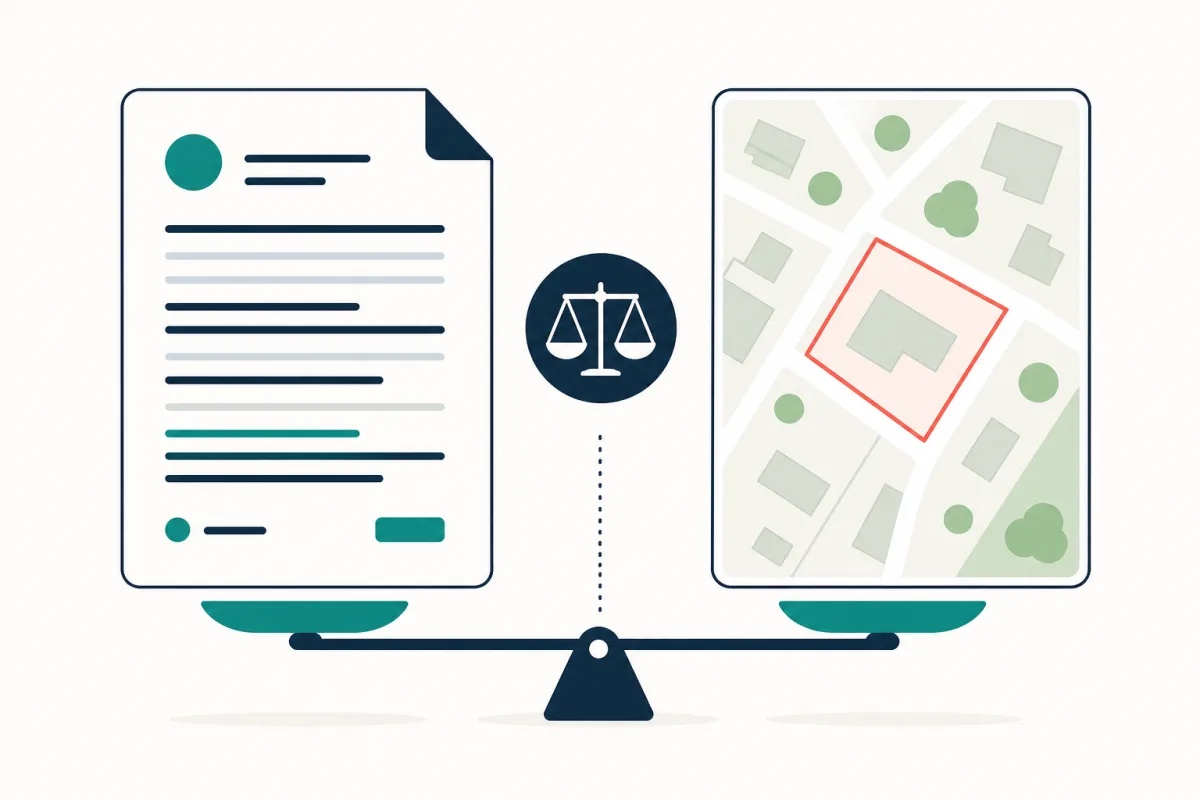
The title register is the written record of a registered property — owner, tenure, rights, covenants and charges. The title plan is the accompanying map, showing the general extent of the land. Each refers to the other, so for most purposes the two documents work best as a pair rather than in isolation.
Two documents, one record
For every registered title in England and Wales, HM Land Registry holds two core documents. The title register is the written record: it names the registered owner, states the tenure where recorded, and lists rights, covenants, restrictions and charges. The title plan is the map: it shows the general extent of the land in the title, usually edged in red on an Ordnance Survey base.
They are not alternatives. They were created as a pair, and each one routinely refers to the other.
Side-by-side comparison
| | Title register | Title plan | | --- | --- | --- | | Format | Written entries in three sections | Map with coloured markings | | Shows the owner | Yes | No | | Shows tenure (freehold or leasehold) | Yes, where recorded | No | | Shows mortgages and charges | Yes, where recorded | No | | Shows covenants and rights | Yes, where recorded | Only as coloured areas the register explains | | Shows the extent of the land | In words, by reference to the plan | Yes, as general boundaries | | Shows precise legal boundaries | No | No — general boundaries only | | Shows the title number | Yes | Yes |
The pattern is easy to summarise: everything about who and what lives in the register, and everything about where lives on the plan — but only in general terms.
When the register is the document you need
Order the title register when your question is about people, rights or money:
- Checking who the registered owner of a property or piece of land is.
- Confirming whether a title is freehold or leasehold.
- Reading restrictive covenants before building or altering a property.
- Checking whether a registered mortgage or other charge exists.
- Finding the title number before instructing a solicitor.
For several of these, the register alone may be enough. If it mentions land "tinted blue" or "hatched brown", though, you will need the plan to see where that land actually is.
When the plan is the document you need
Order the title plan when your question is about the land itself:
- Seeing roughly what land is included in a title — does the title include the garage, the side passage, the strip behind the fence?
- Checking whether a parcel of land is part of a neighbouring title.
- Getting an overview before a purchase, sale or development enquiry.
Keep the plan's limits in mind. It shows general boundaries, so it will not settle exactly where a boundary runs, and its scale means measurements should not be taken from it.
Why both together give the best view
Most real questions cross between the two documents. A covenant in the register may apply only to part of the land, defined by a coloured area on the plan. A right of way shown as a tinted strip on the plan is meaningless until the register tells you who can use it and for what. Reading one without the other is like reading a contract with half the defined terms missing.
That is why conveyancers order both as a matter of routine, and why, for most buyers, sellers and neighbours, the combined order is the sensible default.
How to get the documents
You can order the register, the plan, or both together through our service: we check the address by hand, identify the registered title — contacting you first if more than one title could match — and deliver the PDFs through a secure link. You can also buy directly from HM Land Registry, which usually costs less; our fee covers the human address checking, retrieval, secure delivery and support.
If you are weighing up which to get, the combined register-and-plan order almost always answers more of your question than either document alone.
Title Register vs Title Plan: What Is the Difference? — FAQs
Which document shows who owns the property?
The title register. The proprietorship section names the registered owner and gives their address for service. The title plan does not name the owner at all — it only shows the land the title covers.
Can I order just one of the two documents?
Yes. Each can be ordered separately. But because the register refers to the plan and the plan's markings are explained in the register, ordering one often prompts a second order shortly afterwards. If you are unsure, the pair is usually the safer choice.
Does either document show exact boundaries?
No. The plan shows general boundaries under the general boundaries rule, and the register describes the land in words by reference to the plan. Neither fixes the precise legal boundary line unless a determined boundary has been formally registered, which is rare.
Do the register and plan share the same title number?
Yes. Both documents carry the same unique title number, which is how you match them together. If a property is covered by more than one title, each title has its own register and its own plan.
Which document do solicitors usually ask for?
For conveyancing and most legal work, both. A solicitor reading a covenant that affects "the land tinted blue" needs the plan to see where that land is, and a plan alone says nothing about ownership or charges.
Sources
- HM Land Registry: get information about property and land (GOV.UK)
- HM Land Registry practice guides (GOV.UK)
This guide is general information, not legal advice. Spotted an error? Email support@landregistry-docs.co.uk.