
How to Order Documents for Land Without an Address
Written by Editorial Team · Last reviewed
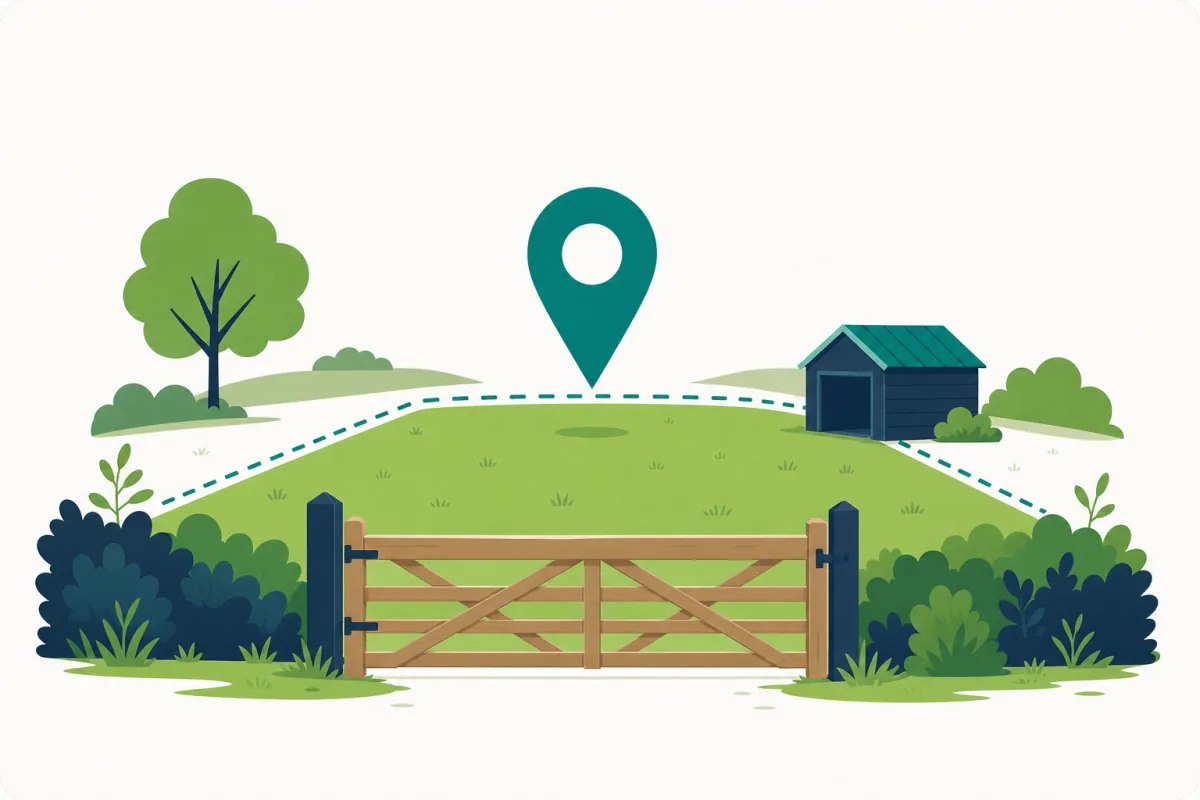
You can order title documents for land with no postal address — such as a field, paddock, garage or strip of verge — by describing where the land is instead. The more location detail you provide (nearest address, nearest postcode, a map pin or coordinates, an annotated map), the faster the registered title can be identified and the documents retrieved.
No address is not a dead end
Plenty of registered land has no postal address: fields and paddocks, garage blocks, woodland, access strips, verges, parcels behind houses. Registration attaches to the land itself, so if the land is registered it has a title number, a title register and a title plan just like any house — there is simply no address to type into a search box.
That changes how the title is found, not whether it can be found. Instead of an address lookup, identifying the title means locating the land on the map and matching it to the registered titles in that area. Good location details from you make that quick; vague ones make it slow or impossible.
What to provide instead of an address
The aim is to let someone who has never seen the land point to it on a map with confidence. Any of the following help, and the more you can combine, the better:
- The nearest address — "the field behind 14 Mill Lane" is a strong starting point.
- A description of the land — what it is (paddock, garage block, strip of woodland), roughly how big, and any landmarks or road frontage.
- The local authority area the land falls in.
- The nearest postcode, even if it belongs to a neighbouring property.
- A map pin, coordinates or a Google Maps link dropped on the land.
- An annotated map or screenshot with the land outlined or shaded.
A pin or annotated map is the single most useful item — it removes almost all of the guesswork.
Checklist before you order
- Note the nearest full address and the nearest postcode.
- Write a one- or two-sentence description of the land and its use.
- Confirm which local authority the land sits in.
- Drop a pin on the land in a maps app and copy the share link, or note the coordinates.
- If the shape matters, mark the land on a map screenshot and save the image.
- Gather anything else you already have — an old deed reference, a title number from paperwork, or an estate agent's plan.
With that in hand, you can place an order through our land without an address service page and attach or paste the details.
Why it can take longer, and what it costs
An address order can often be matched to a title quickly. Unaddressed land is checked by hand against the map, and several candidate titles may need to be examined — a single field can sit across more than one title, and access strips in particular are often registered separately. So allow more time than a standard order.
Two pricing points to be aware of:
- If identifying the land needs significantly more work than a standard order, an additional fee may apply — we contact you before charging anything extra.
- If the land cannot be identified from the details provided, or turns out to be unregistered, a refund may apply in line with our refund policy. We will not simply send you a title that might be the right one.
Once the title is identified, the register and title plan are retrieved and delivered as PDFs through a secure link. You can also buy copies directly from HM Land Registry, which usually costs less; our fee covers the manual map checking, identification, retrieval, secure delivery and support — which is exactly the part that unaddressed land makes difficult.
Which documents to order
For land without an address, the title plan matters as much as the register: the plan shows the general extent of the registered land, which is usually the first thing people want to confirm. Ordering the register and plan together gives the ownership record and the mapped extent side by side.
How to Order Documents for Land Without an Address — FAQs
Can a field or paddock really have a title register?
Yes. Registration attaches to the land, not to a building or postal address. If the field is registered, it has its own title number, register and title plan, exactly like a house — the only difference is that finding the title takes a map-based check rather than an address lookup.
What if I don't know the exact boundaries of the land?
Describe what you can and mark the general area on a map. The title plan, once retrieved, shows the general extent of the registered land, which is often precisely what people ordering for unaddressed land want to see. If several titles cover the area you marked, we contact you before proceeding.
Why might there be an extra fee?
Identifying unaddressed land can involve map searches across several possible titles, and sometimes the area you describe is covered by more than one title. If the work goes beyond a standard order we will contact you first — and if the land cannot be identified at all, a refund may apply in line with our policy.
What if the land turns out to be unregistered?
A minority of land in England and Wales — often rural land held by the same owner for decades — has never been registered. Unregistered land has no title register or plan to retrieve, so we would contact you to explain and discuss refund options under our policy.
Is a Google Maps link good enough?
Usually, yes — a shared pin dropped on the land, together with a short description, is one of the best ways to identify it. Coordinates, what3words-style references or a screenshot with the land outlined all work well too.
Sources
- HM Land Registry: get information about property and land (GOV.UK)
- HM Land Registry practice guides (GOV.UK)
This guide is general information, not legal advice. Spotted an error? Email support@landregistry-docs.co.uk.